
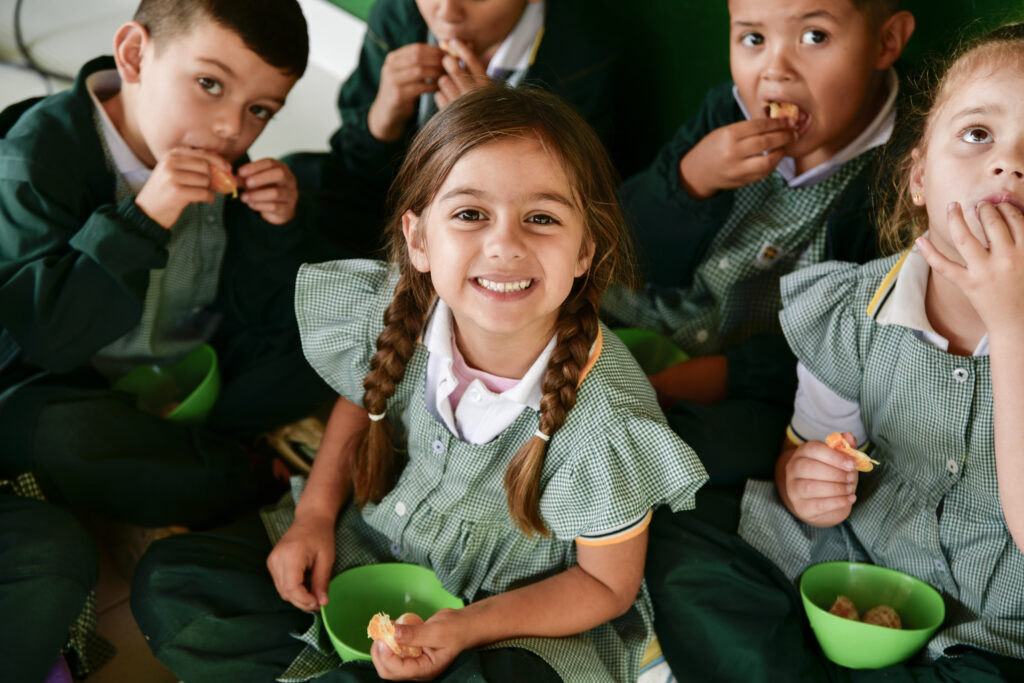
A Catholic school may be full of extraordinary things: teachers who know every child, students learning to serve, families supporting one another through a crisis, and faith woven naturally into the school day. Yet outside the building, prospective parents may know only the tuition, the uniform and the date of the next open house.
That is the gap storytelling can close. Facts tell parents what a school offers. Stories help them picture what it would feel like for their child to be there.
Catholic education already reaches a large and increasingly diverse population. According to the National Catholic Educational Association’s 2025-2026 data, 1,674,907 students attend 5,829 Catholic schools in the United States. More than one in five students – 22.2 percent – are not Catholic, and 2,189 schools reported admissions waitlists. The demand is real, but it is not distributed evenly. Many individual schools still have to help local families understand why Catholic education is both valuable and possible for them.
Stories turn abstract promises into something parents can see
Most Catholic schools use similar language: faith formation, academic excellence, service, community and formation of the whole person. Those ideas are important, but they remain abstract until a family can see them lived.
A profile of a teacher who stayed after school for weeks to help a struggling student makes ‘personalized attention’ concrete. A story about eighth graders organizing a collection for a local shelter gives ‘service’ a face. An interview with parents who were unsure they could afford Catholic education can make financial aid feel approachable rather than theoretical.
Stories do not replace evidence about academics, safety, tuition or outcomes. They give those facts human meaning.
Stories answer the questions parents are often afraid to ask
Prospective parents rarely evaluate a school on academics alone. They also wonder: Will my child be known? Will our family fit in? Is the faith life sincere? What if we are not Catholic? What if we cannot afford the full tuition? What happens if my child needs extra support?
A brochure can state the policy. A well-chosen story can show the experience. When parents encounter families with similar questions, the school becomes easier to imagine and less intimidating to approach.
This is especially important because Catholic schools serve families from many backgrounds. A story written only for insiders may unintentionally assume knowledge that prospective families do not have. Clear, welcoming stories can explain Catholic identity without flattening it and invite curiosity without pretending every reader begins in the same place.
Current families provide the most credible proof
A school can describe itself as caring, joyful and rigorous. A parent’s account of watching a shy child become confident carries a different kind of weight. It offers social proof from someone who once stood where the prospective family is standing now.
The Alliance for Catholic Education makes this principle practical in its guidance for enrollment outreach. Its Catholic school principal’s guide recommends inviting students and families to speak about their experience, using parent testimonials, extending personal invitations and engaging the wider parish. Although that resource focuses particularly on Latino enrollment, the underlying lesson is broadly useful: trusted people and personal relationships can reach families in ways that blanket promotion cannot.
Parish stories reconnect the school to the whole parish
A parish school can be physically close to the church and still feel distant from parishioners who do not have children enrolled. They may hear about the annual fundraiser or see students at a school Mass without understanding what happens in the classrooms every day.
Regular school stories change that relationship. Parishioners begin to recognize teachers, celebrate student achievements, pray for families and understand the school as a ministry of the parish rather than a separate institution sharing the same property. That awareness can support enrollment, volunteering, philanthropy and intergenerational connection.
It also widens the school’s network. A grandparent may pass an article to an adult child. A local business owner may learn about a program worth supporting. A family who attends Christmas and Easter may discover that the school is more accessible than assumed.
A mailed parish magazine reaches families the school does not yet know
School marketing often depends on people finding the school: searching online, following the social account, attending an open house or asking a friend. Parish storytelling can reverse that direction by bringing the school into local homes.
A mailed parish magazine is especially useful because its audience can extend beyond currently enrolled families and active Sunday Mass-goers. A parent may not be ready to complete an inquiry form, but may still stop to read about a teacher, student or family who lives nearby. That story can become a first, low-pressure encounter with the school.
One article will not fill a classroom. But consistent stories build familiarity, and familiarity can lower the barrier to a later conversation.
The school stories worth telling
The strongest stories are not advertisements disguised as articles. They begin with a person, a tension or a meaningful moment. A school might tell the story of a family that nearly chose another option, a teacher whose work is a vocation, a student who found a place to belong, an alumnus serving the community or a parishioner whose scholarship quietly changed a child’s future.
Other valuable subjects include sacramental preparation, service projects, classroom traditions, student leadership, support for different learning needs, parish-school collaboration and the ordinary rhythm of a day. The goal is not to make every story dramatic. It is to make the school recognizable.
Student dignity and safety must remain central. Obtain the appropriate permissions, avoid turning hardship into spectacle and never pressure a family to share more than it wants to disclose. A good story honors the person before it advances the institution.
Every story should offer a next step
Storytelling supports growth most effectively when it connects naturally to an enrollment pathway. A printed profile might include a simple invitation to visit the school, a QR code leading to a landing page, or the name of a real person who will answer questions. The landing page should continue the same story and make the next action clear.
The school can then reuse the material across channels: a photograph and quote on social media, a short excerpt in email, a video follow-up on the website and a printed copy for a tour packet. One strong interview can become weeks of consistent, credible communication.
Growth begins when families can imagine themselves inside the story
NCEA itself is devoting attention to the relationship between authentic marketing and Catholic school enrollment. That is because a school’s story is not separate from its mission. It is how the mission becomes visible to people who have not experienced it yet.
DECM has seen this at the parish level. In a testimonial on DECM’s parish page, Father Josh Johnson of Sacred Heart of Jesus Catholic Church and School said the parish publication strengthened the community and that he observed its greatest impact in school enrollment and Mass attendance. That is one pastor’s experience, not a promise of identical results everywhere. It is also a compelling example of what becomes possible when a parish regularly shares its life beyond the people already in the building.
Families cannot choose a Catholic school whose story they have never heard. Tell that story honestly, consistently and through the people who live it, and more families can begin to see a place for their children within it.
A customized DECM parish magazine can help your church and school bring those stories into homes throughout the community. Request information about getting started.