
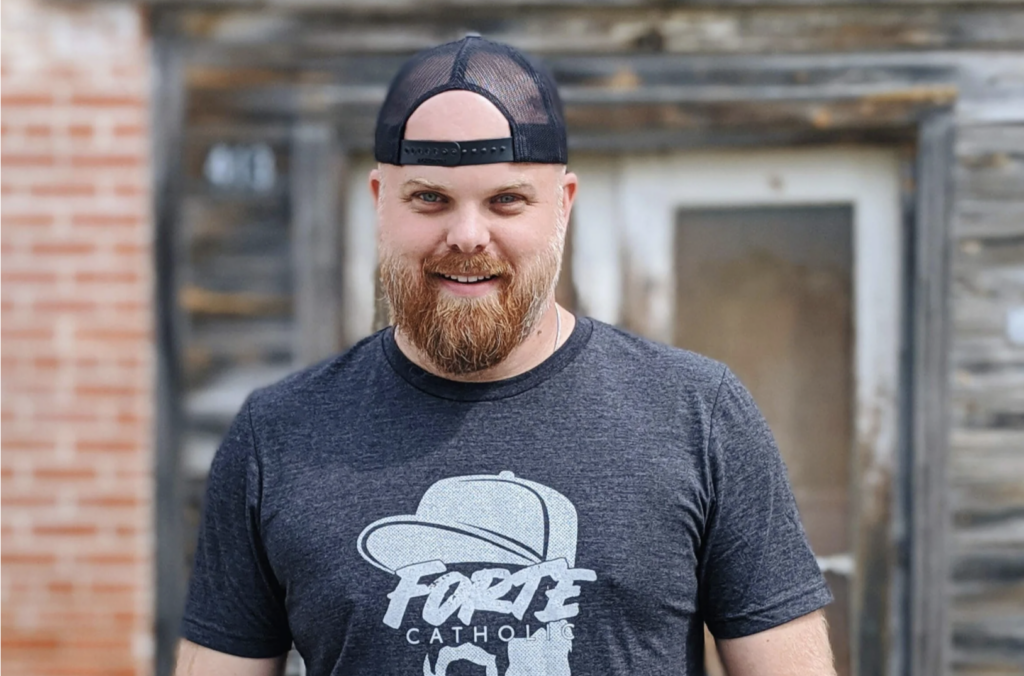
Taylor Schroll of Forte Catholic on Finding Faith and Bringing It Home
For two years, Taylor Schroll’s Sunday mornings came with a compromise: 8 a.m. Mass with his mom, followed by a nondenominational service with his friends.
He calls it “dual citizenship.” He had told his mother he didn’t want to be Catholic anymore. She told him he still had to go to Mass, but she would take him to the other church afterward. There, the Jesus he had heard about growing up began to feel like someone he actually knew. Then, at the Franciscan University of Steubenville, he encountered that same Jesus in the Eucharist.
That experience shaped a vocation that has included youth ministry, music, and the founding of Forte Catholic. Now serving as director of evangelization and catechesis at St. Joseph Catholic Church in Bryan, Texas, Schroll spoke with Decided Excellence’s Isaac Summers about the people who helped his faith become his own, the value of honest Catholic media, and finding a new direction when the work he loved stopped growing.
Questions and answers have been condensed and edited for length and clarity.
What was faith like for you growing up?
I grew up Catholic in Lake Jackson, Texas. Pretty much everybody went to church in town, so it was normal. It was who we were: we went to Mass, watched the Texans play football, and lived the rest of our six days.
Around junior high, that got tough. There were exciting things happening in my life, like sports and video games, and then I went to Mass and religious education and was bored out of my mind. We had a great pastor, but he was the only priest I knew. My vision of Catholicism was very small.
Then my friends started going to a new nondenominational church. They had things geared toward young people, and I realized music could be fun and preaching could be good. I didn’t know that was allowed at church.
What did you find there, and what brought you back to practicing Catholicism wholeheartedly?
My mom said I still had to go to Mass, but if I came to the early Mass with her, she would take me to the other service afterward. For two years, I had dual citizenship.
The exciting atmosphere was part of it, but really, it was the first time I met Jesus through the Scriptures. The preacher clearly loved Jesus and was incredible at breaking open the Word. I fell in love with this Jesus I had learned about in religious education.
Then, the summer after eighth grade, I went to a Steubenville conference. For the first time, I saw the larger Church. Catholics could have good music and dynamic preaching, too. That opened my mind.
The turning point was Adoration. I realized the same Jesus I had fallen in love with in the Scriptures was in that host. If that was true, I wasn’t going anywhere else. That ended my dual citizenship.
What helped that experience become part of your everyday life?
Our youth group became my community. suddenly I had this growing group of people pursuing Christ with me. They were also the people I saw at school and in the locker room.
I had been used to thinking Sunday was Sunday and Friday night was Friday night. But my friends helped me connect the dots. We could say to each other, “You shouldn’t act like that,” and realize the things we heard at church applied to the rest of the week, too.
We were also just friends. After youth group, we would go to Sonic and sit there for two or three hours. Maybe we talked about Youth group for ten minutes, but then just we hung out. I didn’t have to pick Jesus or football. I had to learn to integrate them.
How did that lead you into ministry?
I had such a great experience in youth group that I told my youth minister, “I want your job.” The irony is that I eventually got it. I became the youth minister at that same parish for a couple of years.
Music was actually my first avenue into ministry. In college, I was in a worship band traveling around Texas for retreats and conferences.
I studied music industry and added theology as a second major. Looking back, that combination makes sense: music, theology, and some business are exactly what I ended up doing.
What did you want Forte Catholic to offer?
I started it while working in ministry. It began as a radio show because I thought I could bring a different voice to Catholic media.
Apologetics had been helpful to me in college, but I felt Catholic media could offer more kinds of conversation. I describe our show as youth group for adults. We gather, talk about life, and then something circles back to a Bible verse we’re going to hear at Sunday Mass.
As the show grew, I was invited to speak and lead worship more often. I did Forte Catholic on the side for a long time, then full time for several years. Now I’m doing it part time while working full time at the parish. It has had different places in my life, but it’s still a big part of what I do.

What has shown you that Forte Catholic mattered?
I have a letter from a listener who was in a very similar situation as an adult to the one I was in as a kid. He was Catholic and believed it was right, but he wasn’t connecting. He decided to stay Catholic and also get involved to help improve things at his parish.
I think the honesty of the show helps people. I can say I struggle with a particular sin or that I’m struggling to understand a Church teaching while still assenting to it. I can ask questions.
People listening might have the same question or a different hang-up. Sometimes they didn’t know it was okay to talk about it. That honesty can help them.
Why did you decide to return to parish work full time?
It was about a year of discernment. My team and I had been editing a lot of Catholic podcasts, and I was spending eight to ten hours a day at a computer. Even though the content was good and helping people, that wasn’t good for me physically or mentally.
The work had grown for years, but I wasn’t seeing the same fruit anymore. The pandemic had also disrupted the speaking and music side of things. Eventually, my decision became very practical: I wasn’t making enough to provide for my family, and something needed to change.
I tried both directions. I worked hard to grow Forte Catholic and looked for other jobs. Neither seemed to be working. Then a friend who worked at our parish called to say he was leaving. As soon as he told me, I thought, “That’s my job.” After a year of not knowing, it suddenly became clear.
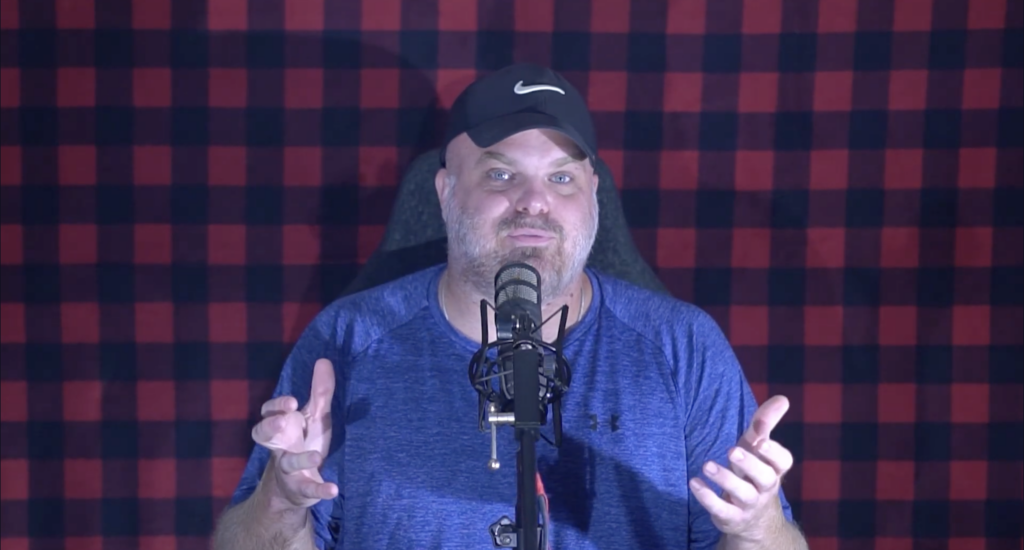
What do you make of that waiting period now?
I think I needed to know I had pursued both options well. If I had stopped a year earlier, I would always have wondered whether I should have done more. I knew I had tried.
The parish work has been the rejuvenation I needed. I’m using all my gifts, and it has been good for my family. Being able to provide for them took away a huge worry.
I think about wanting to go where the people are. In youth ministry, the people were right in front of me. During the pandemic, people weren’t together, and we went digital. Now I’m back at the parish, working with people in person again.
What have your experiences taught you about leading in a parish?
When I was a young youth minister, I was shocked when I had bad experiences working in the Church. Now I’m older, more confident, and in a position where I can help change things.
People who work in churches often want to be nice, but sometimes that means avoiding a problem that needs to be addressed. I want to protect people from some of the hurt I experienced, especially people who are younger or newer to ministry.
That doesn’t mean having a conversation while I’m angry. Recently, I was upset about something on a Friday and asked to meet on Monday because I knew I wouldn’t handle it well that day. We were able to have a calm, truthful conversation. I also have to give the other person room to explain their perspective. Being truthful and calm can be the more loving thing to do.
What excites you most about what is happening at St. Joseph?
We have people coming into the Church, coming back, or finishing their sacraments of initiation. Some have been Catholic their whole lives but stopped being brought to church as children and never got confirmed. Others are coming from different denominations.
It’s exciting to meet people where they are and help them find a path forward. We’ve established different pathways for people to become Catholic or complete their sacraments, depending on their circumstances and the formation they need.
Our pastor makes a lot of that possible. He believes faith formation matters and has invested in the people to do it. The team has grown from one person to a much larger group working in youth ministry, adult formation, marriage ministry, and other areas. Having a supportive pastor who puts his effort and resources into that work makes a huge difference.
Before we go, is it true you were once introduced at a parish as Taylor Swift?
Yes. I was doing music at a parish Mass and got introduced as Taylor Swift. I’ve never seen a more disappointed group of people when I walked out.
It wasn’t a joke. Someone had connected “Taylor” and “music” and said Taylor Swift. Everybody was disappointed. It was great.
Learn more about Taylor’s speaking, music, and media ministry at Forte Catholic.