
The Catching Foxes podcast co-host reflects on the communities, crises and unexpected pieces of media that shaped his faith—and why honest Catholic storytelling helps people recognize that they are not alone.
Before Luke Carey ever helped create a Catholic podcast, Catholic media found him.
One St. Nicholas Day, his parents handed him a copy of HM Magazine, a Christian rock publication filled with punk bands, alternative music and full-page album artwork. They did not know much about the scene. They simply knew their son loved music and thought he might like it.
They were right.
“My mind was blown,” Carey remembers. He began removing the most striking advertisements and putting them on his bedroom wall. The images showed him something he had not fully understood before: Christian art did not have to feel separate from the culture that fascinated him. It could be bold, interesting and genuinely good.
That magazine became one piece of a much larger story—one involving a charismatic Catholic childhood, Star Wars, a Christian punk scene, a decision to leave football, repeated crises of faith, unexpected loss and, eventually, the creation of Catching Foxes.
In this conversation, Carey reflects on the people and experiences that helped make faith real to him, the gap between believing something and living it, and the kind of honest Catholic media he spent years wishing he could find.
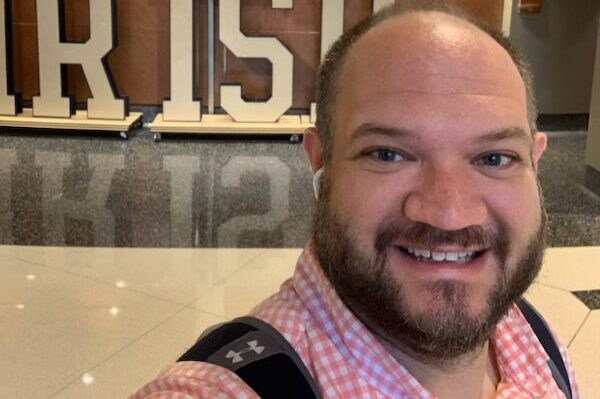
You grew up Catholic, but not in what most people would consider a conventional Catholic household. What did faith look like in your family?
My parents were both very serious about their faith. They were part of the Catholic charismatic movement that emerged alongside the Jesus Movement in the 1970s. They met at a Steubenville conference. My mom initially thought my dad was a bit much, while my dad apparently knew that weekend that he wanted to marry her—which tells you something about both of them.
Because of their background, spirituality interacting with everyday life was never a foreign concept to me. My parents attended prayer meetings, prayed over people and talked about healing. It was simply part of the world in which I grew up.
I joke that Star Wars never seemed that far-fetched to me as a kid. The idea of the Force and the idea of the Holy Spirit were obviously not the same thing—but the possibility that an invisible spiritual reality could affect ordinary life did not seem strange.
Faith was also much larger than our immediate household. My parents’ friends practiced it. Their children practiced it. The people down the block practiced it. One of our neighbors helped teach me the Our Father and the Hail Mary. I grew up seeing adults live their faith in dynamic and interesting ways, so Catholicism was never merely something my family did for an hour on Sunday.
Why did that surrounding community matter so much?
When I was eight or nine, we moved from a diverse urban Catholic community to a suburban town that felt much more culturally post-Christian. I went from being surrounded by people who practiced the faith to attending public school and seeing Catholicism become something my family did more privately.
I am only now, in my early 40s, beginning to understand how significant that change was. Before the move, faith was reinforced by an entire neighborhood. Afterward, I began to notice a separation between my experience and everyone else’s.
That is one reason community became so important to my conversion. When my parents sent me to a Steubenville conference before ninth grade, I remember sitting beside my lifelong friend Dan Hess, who is now a priest. During the invitation to stand and give your life to Christ, I thought, “I’ll do this if Dan stands up.” Then Dan stood up, so I did too.
That may not sound particularly heroic, but it taught me something I still believe: God often speaks through the people in our lives. The witness of someone my own age mattered. It showed me that I was not alone in wanting this.
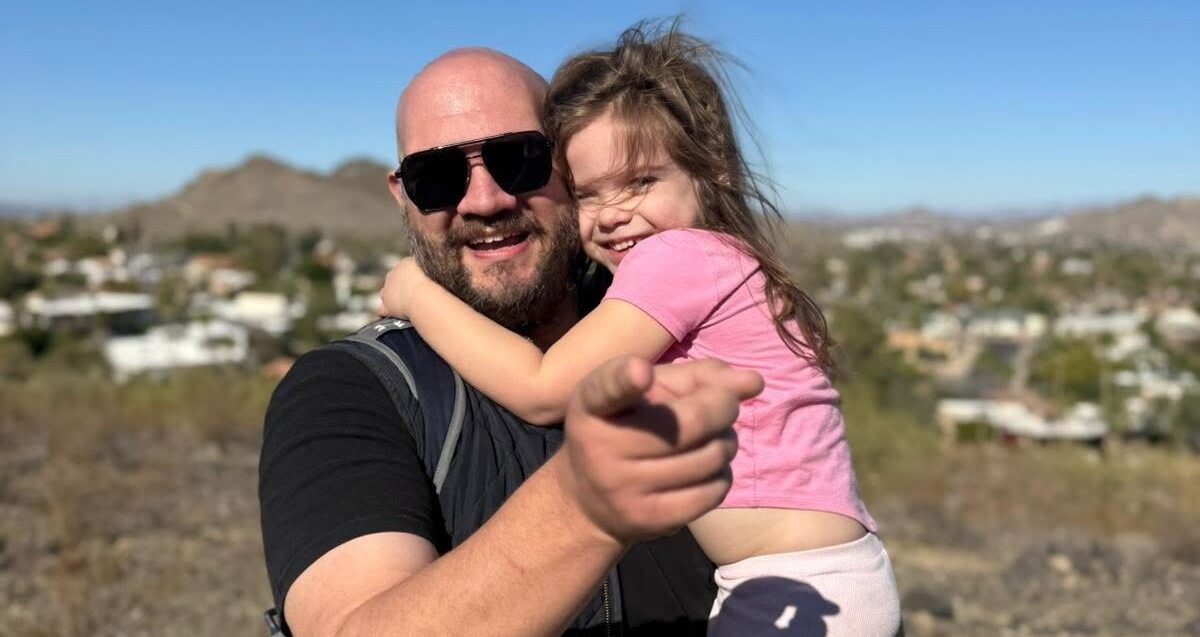
You have said that culture played a major role in your conversion. How?
Culture was huge for me. My parents loved music and pop culture. We listened to everything from Janet Jackson to Amy Grant, and they were always looking for Christian music I might connect with.
Then they gave me HM Magazine. It covered Christian punk, hardcore and alternative music—bands and artwork I had never encountered before. I would tear out the one-page album advertisements and put them on my wall because the art was fantastic.
That affected me deeply. I remember thinking, “Not only is this good art; it is coming from a Christian who may be trying to express Christian ideas.” Suddenly Christianity was not separate from the music, design and culture I cared about. Faith could speak through them.
The magazine led me toward bands, concerts and friendships. I found other young people who loved the same kind of music and were also trying to take their faith seriously. That community was massive for me. It showed me that following Christ did not require me to erase the parts of myself that loved art and culture.
Was there a moment when you felt you had to choose whether the faith would truly become your own?
That happened when I was 16. I played football and was expected to start varsity during my junior year, but I knew the people on the team were not really my community. At the same time, I was becoming more involved in Christian music, conferences and a youth group.
I remember walking through town with my headphones on, listening to a Christian ska song about a soccer player who felt God calling him away from the sport to follow Him. I was going through almost exactly the same thing.
One morning, I sat in the locker room and thought, “I can’t do this. I’m done.” I felt as though I could not continue existing in two different worlds. I had to choose.
So I quit. I handled it in the most immature way possible: I went home and went to bed without properly explaining anything to my coach. I was 16. If I could speak to myself now, I would tell that version of Luke to have an actual conversation.
But the choice itself mattered. I lost a lot of my high-school friends, which was incredibly painful. Then I became much more involved in our youth group, and it felt as though God opened an entirely new world. Some of my closest friends today came from that community.
It included teenagers from Catholic and public schools, different backgrounds and different parts of the city. It was eclectic and a little weird, but something special was happening. We felt that we were part of it together.
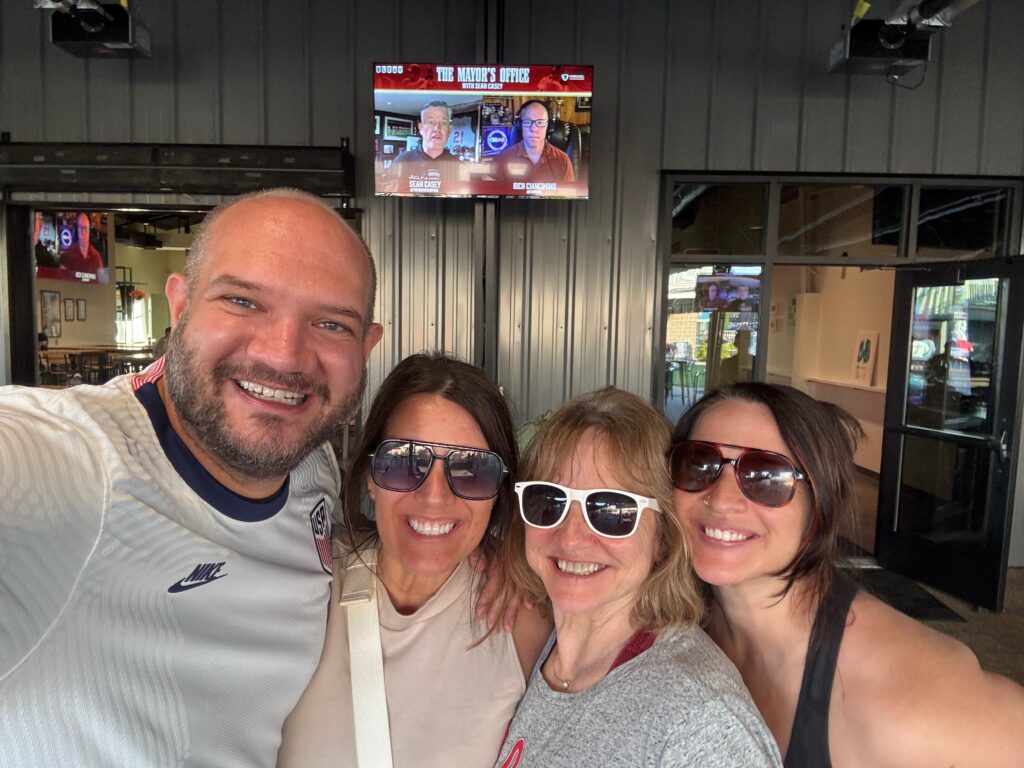
You later attended Franciscan University. How did that experience deepen your understanding of Catholicism?
Until then, my faith had largely been framed as “you and Jesus.” The Church mattered, and I believed in the Eucharist and Confession, but I did not yet understand the full intellectual, historical and artistic depth of Catholicism.
At Franciscan, especially during my semester in Austria, those dimensions began to come together. I encountered Church teaching at a deeper level and started asking not only whether an idea sounded compelling, but whether it accurately described real life.
Living in an old monastery and traveling through Europe also changed me. I encountered the beauty, complexity and long history of the Church—the things it had done well, the things it had done terribly and the ways God had continued working through imperfect people across centuries.
My world kept expanding. I began to see more clearly how faith and reason belonged together, and how the Church was more than an institution surrounding my private relationship with Jesus. It was the Church.
You describe your conversion as a series of “concentric circles.” What do you mean by that?
I keep encountering many of the same questions, but at a deeper level each time.
For most of my life, there has been a gap between the idea of faith and my lived experience of it. I can believe something intellectually while still recognizing that my actual life does not reflect it. Every few years, God seems to bring me back to that divide and show me something I could not see before.
During college, a beach evangelization trip exposed that gap like an open wound. I had to ask myself: Do I really believe this? If I do, why am I so reluctant to act as if it is true?
A few months later, I attended the Cornerstone music festival while I was in the middle of that struggle. My favorite band, Five Iron Frenzy, was preparing to break up, and I believed it might be the final time I would ever see them perform.
During one of their last songs, I began sobbing. I remember thinking, “If God isn’t real, then this isn’t real.” I could not dismiss the longing I felt to be close to Him.
My eyes were closed and my hand was raised when someone grabbed it. I opened my eyes and saw that it was the band’s lead singer. He was crying too. Then the singer from the band whose song had accompanied my decision to quit football came onto the stage.
It felt like my story folding back in on itself. I do not mean that an entire concert existed just for me. But in that moment, I felt God using the things I loved to remind me: “I have always been with you.”
That pattern has continued throughout my life. God reveals the deeper parts of my heart, including the parts I would rather keep hidden, and then begins to heal them. He reveals and He heals. Good ministry does the same.
What did faith look like during the more painful and uncertain years of your life?
My early 20s were tremendously difficult. One of my best friends died unexpectedly shortly after I had visited him. The economy collapsed. I struggled to find stable work and began wondering whether there was something fundamentally wrong with me.
Years later, I learned that many of the things I had treated as character defects were connected to undiagnosed ADHD. I was not simply lazy or careless; I had real difficulties with executive functioning, time blindness and impulsivity that I needed to understand and manage.
Then, just before I was supposed to move to California for a new job, my dad died unexpectedly. Days earlier, I had felt a sudden impulse to give my younger sister my car and delay my departure. Because of that decision, I was still home.
Before the ambulance arrived, I tied my dad’s shoes. I remember thinking, “If this is the last thing I ever do for my dad, I’m okay with it.”
There was real grief, but there was also a profound experience of grace in being present. When I later question whether God is real, I return to moments like that—moments in which I felt cared for in a way I could never have arranged myself.
None of those experiences tied life into a neat bow. They did, however, teach me that God often works through our personalities, limitations and imperfect motives. My willingness to make extreme moves may have been partly a desire to serve Him and partly my ADHD chasing dopamine. It was probably both. That is often how God works: He meets us in the complicated reality of who we are.
How did all of this eventually lead to Catching Foxes?
In 2014, I was back in California, walking around, smoking a cigarette and feeling as though I had completely botched my career. I kept asking God, “What are You doing? What do You want me to do?”
Once again, I felt that gap between faith and real life. I did not know where to take the confusion.
Then I heard people on a soccer podcast talking about how they had started their show. They had simply decided to do it. That made me return to a podcast idea I had discussed years earlier but never pursued.
I realized the podcast I wanted to hear did not exist. I wanted the vulnerability of long-form interview shows, the freedom to discuss culture and the open-endedness of the early podcasts I loved—but with an authentically Catholic voice.
So I called my friend Michael Gormley, whom we call Gomer, and asked, “What if we made it?”
We gave ourselves permission to take 100 episodes to find our voice in the Catching Foxes podcast. We committed to discussion over instruction because I was tired of Catholic media always telling people what to do. I wanted us to admit that living the faith could be confusing and difficult. We wanted to be honest without being needlessly scandalous and to talk about the parts of life that rarely arrived in a tightly packaged Catholic presentation.
Our first attempts were terrible. We recorded five episodes and never released them. But we kept asking how the show could become more honest and more useful.
Eventually, we recorded a vulnerable conversation that made me think, “We did it. This is the thing I have been looking for.” The podcast found an audience quickly because people were hungry for that kind of candor. They needed to hear other Catholics say, “This is hard for me too.”

After nearly 500 episodes, what fruit have you seen from that honesty?
The greatest fruit is that people feel less alone.
The Catching Foxes podcast has encouraged listeners to face the darkness in their own lives. It has also forced Gomer and me to do the same. We have made plenty of mistakes, and the show has never been perfectly polished, but it has given us a place to tell the truth about what it means to keep trying.
I have a speech impediment, and I will never forget meeting someone at a SEEK conference who had one too. He told me that hearing me gave him the courage to go out and evangelize. That meant an enormous amount to me.
In many ways, the Catching Foxes podcast recreated the kind of community that formed me when I was young. Back then, I was surrounded by people who were trying to experience life and faith together. The podcast opened that circle to other people.
Ultimately, it is an ongoing conversation about what it means to live life on Holy Saturday—to know what Christ has promised while still inhabiting the tension, uncertainty and waiting of ordinary life.
That tension does not mean God is absent. Sometimes it is precisely where He finds us.
Listen to the Catching Foxes podcast here!